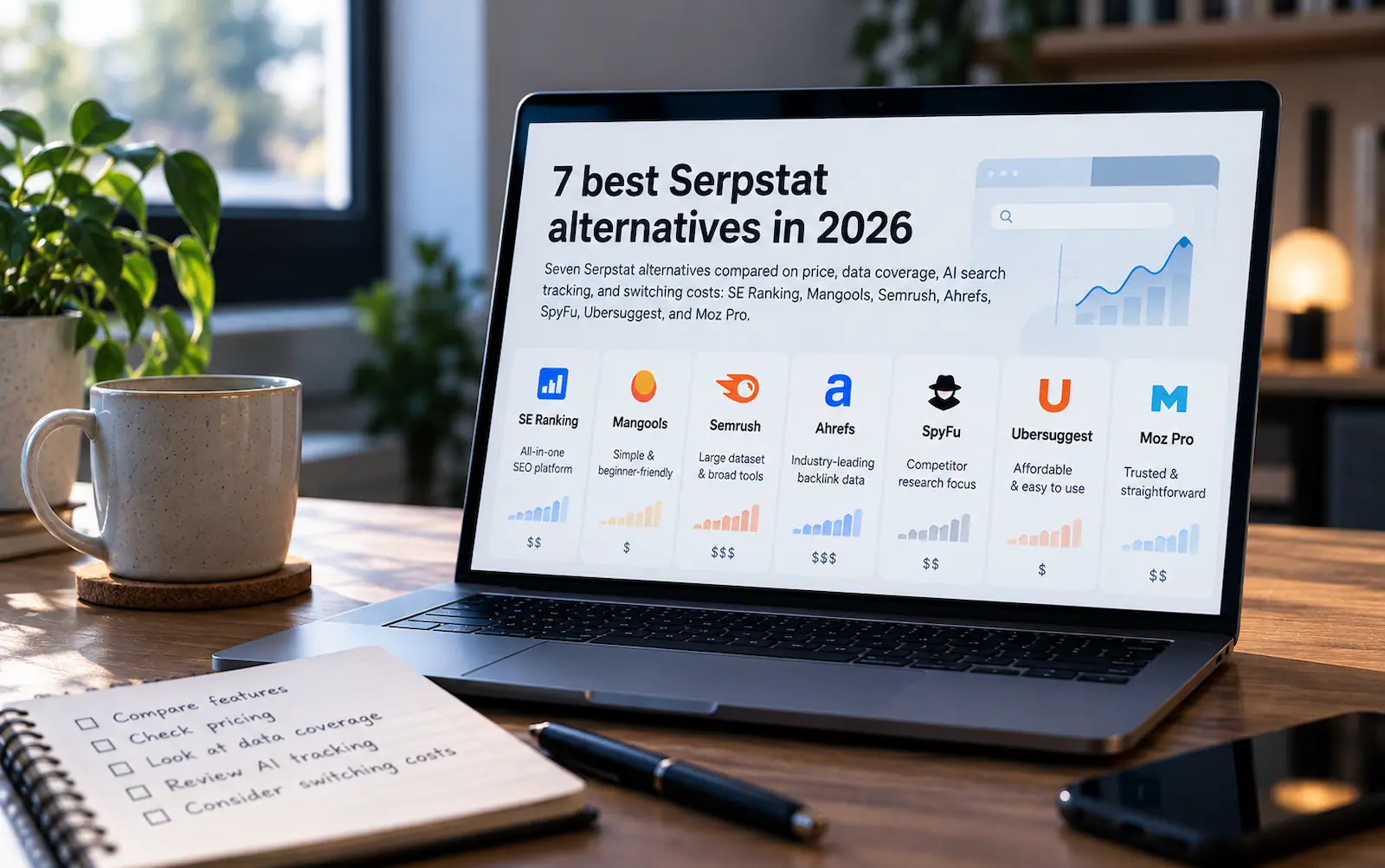
7 best Serpstat alternatives in 2026
All prices were checked against each vendor’s own pricing page on October 18, 2026. The links in each section point to those pages.
Serpstat brought keyword research, site audits, rank tracking, and competitor analysis together at a price that appealed to budget-conscious users. Its entry plan now costs $69/month ($50/month billed annually), with agency features at $129 to $499/month. Price has become less of a reason to choose it.
Choose a replacement based on why you’re leaving:
- If the price no longer works, Mangools, Ubersuggest, and SpyFu cost less. SE Ranking, Semrush, and Ahrefs cost more.
- Semrush and Ahrefs have deeper keyword data, more frequent SERP refreshes, and better backlink coverage in North America, Western Europe, and APAC.
- SE Ranking, Semrush, Moz, and Mangools all include some form of AI search visibility tracking. Serpstat has added AI Overviews keyword tracking, so compare which engines each tool covers.
- Ahrefs runs its own crawler and finds new and lost backlinks faster.
If cost is the problem, check the free and single-purpose tools before paying for another suite.
Serpstat alternatives at a glance
Serpstat’s own entry price is the baseline: $50/month billed annually, $69/month billed monthly.
| Tool | Reason to switch | Starting price (annual / monthly) | Free trial / tier | What you give up |
|---|---|---|---|---|
| Serpstat (baseline) | n/a | ~$50 / $69/mo | 7-day trial | n/a |
| SE Ranking | Interface, client reporting, local tracking, AI visibility | ~$103 / $129/mo | 14-day trial, no card | Costs more; clustering can use extra credits |
| Mangools | Price, simplicity | ~$37.70 / $61/mo | 10-day trial, no card | No technical crawler; 100 daily lookups on Basic |
| Semrush | Data depth, AI visibility, PPC research | ~$117 / $139.95/mo | 7-day trial | About double Serpstat’s price; seats and add-ons extra |
| Ahrefs | Slow backlink discovery, content research | ~$108 / $129/mo (or $29/mo Starter) | Ahrefs Free tier | No paid trial; credit-based limits |
| SpyFu | Cost of competitor PPC research | ~$29 / $39/mo | 30-day money-back guarantee | Lighter site audit than Serpstat; weaker backlink index |
| Ubersuggest | Price, no lifetime option | ~$29/mo (or $290 lifetime) | 7-day trial | Smaller database; limited reporting |
| Moz Pro | Clients who ask for Domain Authority | ~$39 / $49/mo | 7-day trial (Medium plan) | Weekly rank tracking on entry plans; slow crawler on large sites |
Why people leave Serpstat
The price jump
Early AppSumo lifetime deals and sub-$20 monthly plans helped Serpstat attract its first users. The entry plan now starts at $69/month, or $50/month with annual billing. Agency features cost $129 to $499/month.
Compare reporting tools, client access, and ease of use alongside the subscription fee. Several alternatives cost more than Serpstat, so switching won’t necessarily save you money.
Data coverage in your target market
Serpstat’s early indexes focused on Eastern Europe and CIS territories. It has since expanded and now reports over 8 billion keywords across 230+ regional databases. Semrush and Ahrefs have deeper keyword data, more frequent SERP refreshes, and better backlink coverage in North America, Western Europe, and APAC.
Tracking visibility in AI search
If you monitor Google AI Overviews, ChatGPT Search, or Perplexity, you need to see where they cite your brand. Several competitors include generative engine optimization (GEO) tracking. Serpstat now includes AI Overviews keyword tracking on its paid plans. If you monitor ChatGPT Search or Perplexity specifically, check which engines each tool covers before subscribing.
Finding new and lost backlinks
Dedicated link crawlers can find new and lost links faster than Serpstat’s backlink analysis. Those delays affect campaign reporting when link building or digital PR is a big part of your work.
Time spent navigating reports
Moving between project modules, filtering large keyword lists, and pulling reports can still take extra clicks and page reloads, despite improvements to Serpstat’s interface. That time adds up when you repeat the work across client accounts.
What you lose when you leave Serpstat
Serpstat reports 230+ regional databases, while Semrush lists 142. Semrush’s keyword count is more than three times larger (28.9 billion vs 8.9 billion), with deeper coverage in North America, Western Europe, and APAC. If your market is Eastern Europe, the CIS, or another smaller region, test your own keywords during a trial to check whether the larger database has better data for you.
Serpstat includes keyword clustering in its standard allowances. SE Ranking can charge extra credits for high-volume clustering, so check the allowances if you regularly group large keyword lists.
Your new tool won’t reproduce Serpstat’s domain score. Moz uses Domain Authority and Page Authority; Ahrefs uses Domain Rating. Semrush has Authority Score, and Mangools shows Majestic’s Trust Flow and Citation Flow. These numbers aren’t interchangeable, so set a new baseline for client reports that include a domain metric.
Export your tracked-keyword and rank history before your plan ends. Some history may not carry over, and keeping a copy gives you a baseline for comparisons.
The 7 best Serpstat alternatives
1. SE Ranking: an easier switch for agencies
SE Ranking covers keyword research, rank tracking, competitor analysis, and site audits, so it can take over Serpstat’s core tasks. The cleaner dashboard makes it the easiest switch if you’re frustrated with the interface or client reporting. Core costs more than Serpstat’s entry plan.
Local rank tracking goes down to city and postal code level across Google, Google Maps/Local Packs, Bing, and YouTube. All tracked keywords get daily updates on standard tiers. Every plan includes AI visibility tracking: 100 prompts a day across five AI platforms on Core, covering AI Overviews, AI Mode, Perplexity, and ChatGPT. Agencies get white-label reporting and client seats through the Agency Pack add-on ($69/month, annual billing only) rather than an enterprise contract.
Check the clustering allowance if you group large keyword lists: high-volume clustering can require extra credits, whereas Serpstat includes it in its standard allowances. Give yourself a few days to learn the other modules, including social media scheduling, on-page SEO checks, and content marketing.
SE Ranking’s pricing (annual billing saves 20%):
- Core:
$129/month ($103.20/month billed annually). 10 projects, 2,000 keywords tracked daily, 1 manager seat, 250,000 pages audited per month. - Growth:
$279/month ($223.20/month billed annually). 30 projects, 3 manager seats, 5,000 keywords tracked daily, project-lifetime historical data, guest collaboration links, API access. - Enterprise: custom pricing.
- Free trial: 14 days, no credit card required.
2. Mangools: the cheapest choice for keyword research
Mangools is the clearest choice if you mostly do keyword research and want to spend less. It has five connected apps. KWFinder handles keyword research and search volume, while SERPWatcher tracks rankings and includes a visibility index. SERPChecker shows search results and competitor metrics. For backlink analysis, LinkMiner uses Majestic’s Trust Flow and Citation Flow; SiteProfiler gives you domain authority and traffic snapshots.
Mangools’ pricing starts at $37.70/month billed annually ($61/month billed monthly), below Serpstat’s $50 to $69 entry price. It is worth knowing that Mangools raised every tier on October 9, 2026, so older reviews quote lower numbers. KWFinder’s Keyword Difficulty (KD) score helps you judge competition. Its uncluttered interface is also easier to learn than dense project menus. Every paid plan includes the five core tools and AI Search Watcher; only the usage allowances differ.
You’ll need a separate crawler such as Screaming Frog to replace Serpstat’s site audit. Mangools has no full technical crawler for broken canonicals, redirect loops, or schema validation errors. A long research session can use up Basic’s 100 daily keyword lookups. LinkMiner’s Trust Flow and Citation Flow won’t match Serpstat’s domain score, so reports that use it will need an adjustment.
Pricing (annual billing saves about 38%):
- Basic:
$61/month ($37.70/month billed annually, $452.40/year). 100 daily keyword lookups, 200 tracked keywords, 100k monthly backlink rows, 1 user seat. - Premium:
$81/month ($52.70/month billed annually). 500 daily lookups, 700 tracked keywords, 3 extra user seats. - Agency:
$141/month ($97.70/month billed annually). 1,200 daily lookups, 1,500 tracked keywords, 5 extra user seats. - Free trial: 10 days, no credit card required.
3. Semrush: deeper data and AI visibility tracking
Semrush has over 28.9 billion keywords across 142 regional databases. Serpstat lists more regional databases (230+) but less than a third as many keywords. Beyond organic SEO, Semrush covers Google Ads research, social media management, PR monitoring, local listing distribution, and AI content creation. It can suit a team that needs to cover several marketing functions from one software budget.
For data depth in North America, Western Europe, and APAC, Semrush is the strongest option. Its higher tiers track visibility in Google AI Overviews, ChatGPT, Perplexity, and Gemini alongside traditional rankings. Its paid search tools go further than Serpstat’s basic PPC reports: you get historical ad creatives, display ad positioning, Google Shopping PLA intelligence, and competitor ad spend estimates going back over a decade. The Pro+ tier adds historical data, content optimization, and keyword cannibalization analysis.
The price can be hard to justify at $139.95/month ($117.33/month annually), about double Serpstat’s entry plan. Extra seats start at $45 per user per month. Add-ons add up: lead generation is $90/month, and report add-ons run $10 to $20/month each.
- SEO:
$139.95/month ($117.33/month billed annually). 5 websites, 500 tracked keywords, Site Audit, basic AI search tracking. - Starter:
$199/month ($165.17/month billed annually). Adds MCP access, 50 AI prompts tracked daily, and AI brand reporting for one domain. - Pro+:
$299/month ($248.17/month billed annually). 15 websites, 1,500 tracked keywords, historical data, content optimization. - Advanced: custom pricing. 40+ websites, 5,000+ tracked keywords, API access, share of voice.
- Free trial: 7 days with a credit card; a limited free account also exists.
4. Ahrefs: faster backlink discovery
Ahrefs grew from a backlink crawler into a full SEO suite. It’s the most direct replacement if Serpstat’s link data arrives late or goes missing.
Ahrefs maintains its backlink index with AhrefsBot, its own crawler. Site Explorer finds links faster than Serpstat and reports referring domains, anchor text, and lost backlinks. Content Explorer searches over 23 billion pages by social shares, organic traffic, referring domains, or author. Serpstat has no equivalent. For keyword research, Ahrefs combines Google Keyword Planner figures with anonymized clickstream data to estimate both search volume and clicks per search.
Heavy use can exhaust the monthly credit allowance. Filtering tables, exporting rows, and opening reports all use credits. There’s no public free trial for paid plans, unlike Serpstat’s 7-day trial. You can test some data for free through Ahrefs Free (the renamed Ahrefs Webmaster Tools), which gives verified site owners technical audits and backlink monitoring. Support is through live chat and documentation; there’s no phone line.
Ahrefs’ pricing (annual billing saves up to 17%):
- Ahrefs Free: free Site Explorer and Site Audit for sites you verify through DNS or Google Search Console.
- Starter: $29/month, monthly billing only. Limited keyword and backlink lookups.
- Lite: $129/month (~$108/month billed annually). 5 projects, 750 tracked keywords, 6 months of history.
- Standard: $249/month (~$208/month billed annually). 20 projects, 2,000 tracked keywords, full Content Explorer, 2 years of history.
- Advanced: $449/month (~$374/month billed annually). 50 projects, 5,000 tracked keywords, webhooks, Looker Studio integration.
5. SpyFu: cheaper competitor research
SpyFu costs less than Serpstat for studying competitors’ search campaigns. Enter a domain to see its recorded organic keywords, paid keywords, and ad copy history.
Basic caps search results and data exports at 10,000 rows each. Professional and Team plans are unlimited. The historical PPC records go back over a decade and cover Google Ads copy, split tests, ad spend projections, and bidding strategies. Professional plans and up integrate RivalFlow AI to compare your content with competing pages and recommend copy changes.
SpyFu has added a site audit, but it is newer and lighter than Serpstat’s: 50,000 crawl pages per month on Basic, 500,000 on Professional. Backlink research remains a secondary feature, with a smaller index that updates less often than those of dedicated link crawlers. The interface is dense with data and feels less polished than SE Ranking’s dashboard.
Pricing (annual billing saves 25%):
- Basic:
$39/month ($29/month billed annually). 1 user seat, 10k-row search results and exports, 1 live site tracking project, 5k weekly tracked keywords, site audit. - Professional:
$119/month ($89/month billed annually). Unlimited searches and exports, 15k weekly tracked keywords, white-labeled reports, API access. - Team:
$249/month ($187/month billed annually). 5 user seats ($30 per additional), 50k weekly tracked keywords, unlimited site projects. - Guarantee: 30-day money-back on all plans.
6. Ubersuggest: a one-time payment option
Ubersuggest began as a free keyword scraper before Neil Patel acquired and expanded it. It now covers basic keyword research, rank tracking, and site audits for entrepreneurs, small e-commerce businesses, and freelance marketers.
Ubersuggest is the only option here with a one-time license, at $290 to $990 for permanent access. Serpstat discontinued its earlier lifetime promotions. You get step-by-step recommendations for fixing errors, improving page titles, and addressing content gaps. Its Chrome extension puts search volume, CPC, and competitor domain metrics directly in Google search results.
The database is smaller than Serpstat’s, and very low-volume keywords or niche regional queries may return no data. Test those queries if regional coverage is why you chose Serpstat. Limited report customization and rank-tracking frequency make Ubersuggest a weaker fit for agency work than SE Ranking or Semrush.
- Individual: ~$29/month or $290 lifetime. 1 site/project, 150 daily searches, 125 tracked keywords per project.
- Business: ~$49/month or $490 lifetime. Up to 7 sites, 300 daily searches, 150 tracked keywords per project.
- Enterprise/Agency: ~$99/month or $990 lifetime. 15+ sites, 900 daily searches, 300+ tracked keywords per project.
- Free trial: 7 days on monthly subscriptions. Lifetime plans have a 30-day refund guarantee.
7. Moz Pro: for clients who use Domain Authority
Moz developed Domain Authority (DA) and Page Authority (PA), two widely used SEO metrics. Moz Pro makes the most sense for digital PR teams, link marketplaces, or brands that judge link quality using DA. Since Serpstat has its own domain score, the choice largely depends on which metrics your clients use.
Marketing departments and outreach partners are familiar with DA and Spam Score. The MozBar extension shows DA, PA, and on-page attributes as you browse. Subscribers also get educational courses and practical SEO breakdowns, along with community Q&A forums. Moz now tracks brand visibility in GPT, Gemini, Google AI Mode, and Perplexity answers.
Entry-level plans update rankings weekly by default, so they’re less useful for a volatile campaign. Moz’s crawler can also be slow on sites with hundreds of thousands of pages. Starter tracks only 50 keywords.
Moz Pro pricing (annual billing saves about 20%):
- Starter: $49/month (~$39/month billed annually). 1 site campaign, 50 tracked keywords.
- Standard: $99/month (~$79/month billed annually). 3 campaigns, 300 tracked keywords, 400,000 pages crawled per month.
- Medium: $179/month (~$143/month billed annually). 10 campaigns, 1,500 tracked keywords, branded reports, 2 user seats.
- Large: $299/month (~$239/month billed annually). 25 campaigns, 3,000 tracked keywords, 3 user seats.
- Free trial: 7 days on the Medium plan, monthly billing with a card on file.
Free and single-purpose replacements
You may be able to replace several Serpstat jobs with free tools for sites you own, without paying for another full suite:
- Google Search Console shows queries, clicks, and average position for your own verified site.
- Ahrefs Free gives Site Explorer and Site Audit access for verified sites, covering technical audits and backlink monitoring.
- Screaming Frog SEO Spider is free for up to 500 URLs, and $279/year per licence for the unlimited version. It’s a desktop crawler for deeper technical audits, with JavaScript rendering, hreflang analysis, internal link analysis, XML sitemap checks, structured data validation, and custom regex extraction.
These tools work on sites you can verify or crawl. For competitor research or keyword volumes for other sites, you’ll need another tool:
- LowFruits handles long-tail keyword research. Pay-as-you-go credits start at $25 for 2,000 credits, and subscriptions start at $29.90/month ($20.75/month billed yearly). It examines live search results for low-competition queries and flags pages where forums, Reddit, Quora, or low-DA sites rank on page one.
- Nightwatch handles rank tracking and AI visibility, with plans starting at €79/month billed yearly. It tracks Google, YouTube, Bing, Yahoo, DuckDuckGo, and Google Maps, plus AI answers in ChatGPT, Claude, Gemini, Perplexity, Google AI Mode, and AI Overviews. White-label client reports start on the Professional plan.
Which Serpstat alternative should you choose?
For a smaller bill, Mangools covers keyword research at $37.70/month billed annually, with Screaming Frog’s free tier for audits. Ubersuggest is the one-time-payment option, and SpyFu handles competitor ad research for less than Serpstat. SE Ranking, Semrush, and Ahrefs all cost more than the entry plan.
For data coverage in North America, Western Europe, or APAC, test Semrush or Ahrefs on your own keywords during a trial, especially in a smaller regional market.
For AI search visibility, SE Ranking, Semrush, Moz, and Mangools all track it; Mangools is the cheapest of the four. Serpstat now tracks AI Overviews keywords as well, so compare engines covered.
For faster backlink discovery, choose Ahrefs, and verify a site in Ahrefs Free before paying. For a smoother interface and client reporting, SE Ranking is the easiest switch. For competitors’ ads, start with SpyFu’s history and unlimited searches, or Semrush if you need broader marketing data. Choose Moz Pro if your clients ask for Domain Authority.
Before you switch
Use a free trial to test the work you do regularly. SE Ranking gives you 14 days and Mangools 10, both without a card. Semrush, Moz, and Ubersuggest offer 7 days. Ahrefs has no paid trial, though you can use Ahrefs Free. SpyFu offers a 30-day money-back guarantee.
During the trial:
- Pull 10 to 15 keywords from Serpstat that reflect your actual market, including a few low-volume or regional ones.
- Run the same keywords in the new tool. Compare their relative difficulty, since each tool has its own data sources and difficulty scale. The numbers won’t match exactly across tools.
- Rebuild the report or export you use most, and time how long it takes.
- Export your Serpstat keyword and rank history before you cancel.