DeepSeek’s Search API Gives SEO a New Place to Look
If an AI assistant overlooks a useful page on my website, I’d like to know where the process broke down. Did its search find the page? Did it retrieve enough information to understand it? Did another source answer the question better? The final response alone can leave all of that unclear.
DeepSeek opened its in-house search engine to developers on October 17, 2026. Reading Matt G. Southern’s coverage in Search Engine Journal, what caught my attention was the information exposed alongside the results: a page authority tier and a score tied to the query.
For someone working on SEO, that creates an opportunity to inspect an earlier part of the process. You can look at which pages the search engine returns before trying to understand why an assistant cites a particular source.
What the Search and Fetch APIs expose
An API lets software request information from a service. DeepSeek’s Search and Fetch guide describes two services: Search returns structured web results for a query, while Fetch retrieves an individual page as Markdown, a text format that preserves elements such as headings and links.
The queries support operators SEO work already leans on. site: restricts results to a given site, -site: excludes one, and quoted phrases match exact wording. lang: narrows results by language code, and after: and before: restrict results to pages published around a given date. A query runs up to 128 characters, and a request can ask for 1 to 50 results, with 10 returned by default.
For marketers, the result fields are especially interesting. DeepSeek’s Search API reference documents these two scores:
| Field | What DeepSeek says it represents |
|---|---|
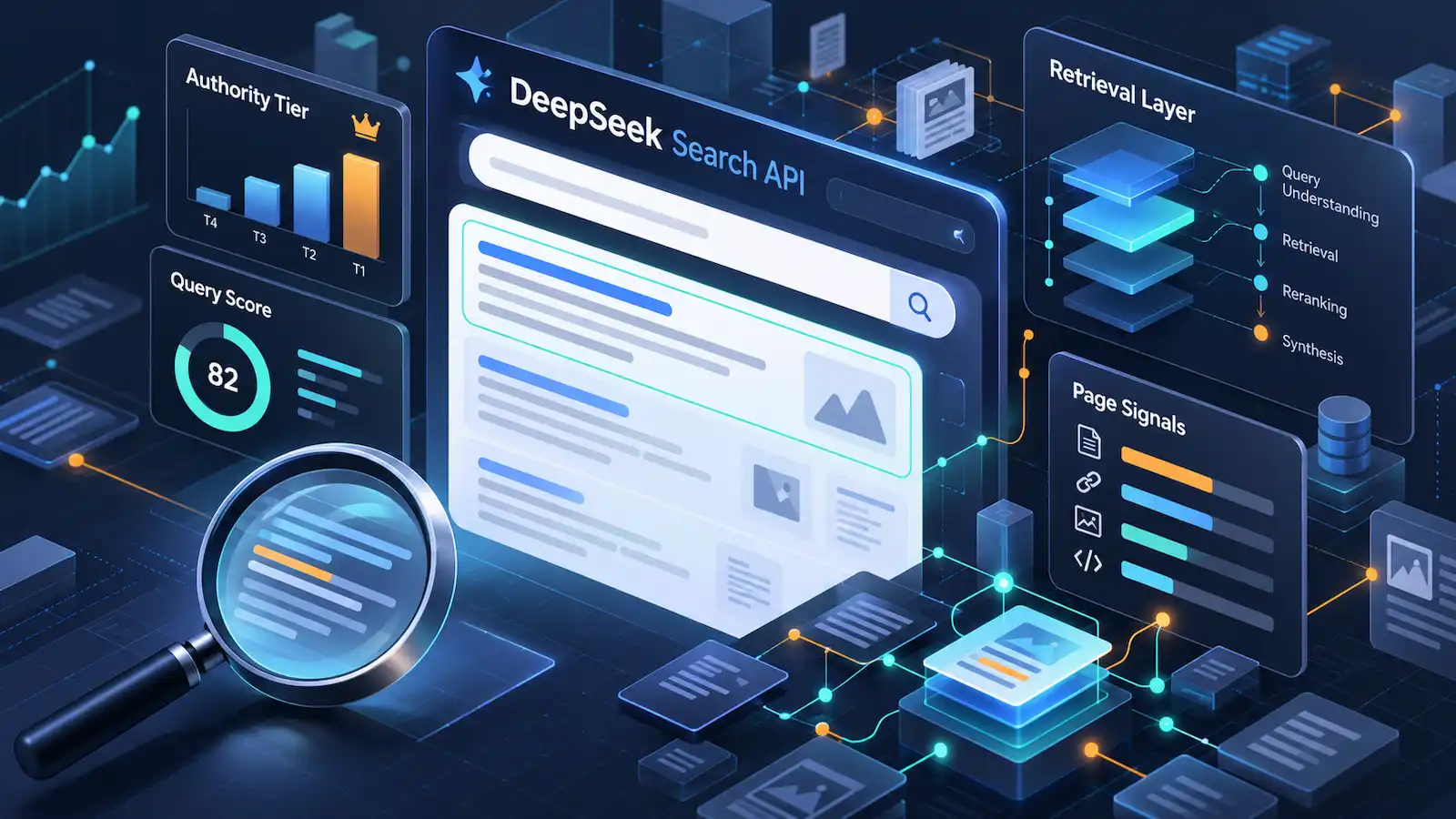
authority | A page authority tier from 0 to 4. A value of -1 means unknown; tiers of 3 or higher indicate highly authoritative sources. |
rerank_score | A score from 0 to 3 combining relevance, authority, freshness, and other signals. DeepSeek describes results scoring at least 1.5 as high quality. |
Each result also carries the page’s title, URL, site name, and publication date, plus two written summaries: a snippet of roughly 100 to 200 characters intended for display, and a longer one of roughly 600 to 800 characters the documentation says is intended to be read by a model. Page content can be requested with the call, although it may be unavailable.
Treat these fields as observations about DeepSeek’s assessment of a page. The documentation leaves the calculation behind the scores unexplained. A score can identify something worth investigating, but the page itself still has to answer the question accurately.
A returned page is a candidate source. An assistant still has to select information and compose its response. Seeing your page in Search establishes that it appeared for that request; a claim about actual citations would require checking the resulting answers too.
The claim about filtering GEO manipulation needs more detail
DeepSeek’s October 17 changelog says its engine filters SEO spam, GEO manipulation, and low-quality AI-generated content. It also says the engine indexes hundreds of billions of pages and handles hundreds of millions of daily searches. Those are the company’s claims; this article does not independently verify them.
GEO, or generative engine optimization, generally means working to make content more visible in answers produced by AI systems. That can include making an explanation clearer, supporting claims with evidence, and helping a system identify what a business actually offers.
The word manipulation leaves an important question open: which practices does DeepSeek put in that category? As Search Engine Journal reports, the launch material leaves both the definition and the detection process unexplained.
Be careful about turning that statement into an optimization checklist. If you publish a comparison of two products, you can explain your criteria, show where the information came from, and make the tradeoffs clear. Those are improvements you can defend to a reader. Claiming to know which wording will satisfy an undisclosed filter would require evidence I don’t have.
The same caution applies when a page fails to appear. One missing result tells you very little about the cause. Investigate coverage, the query, and competing results before attributing the absence to a filter.
What Search can show about your own site
The operators make a small, repeatable investigation possible. A query like site:example.com email marketing returns only that site’s pages, with their scores and summaries. Run the same words without the site restriction and you see the competing sources in the order DeepSeek ranks them. Comparing a returned summary with its source page shows what information survived retrieval, and a summary that misses the page’s main point is a concrete finding you can act on.
Two cautions keep the work honest. A technical query surfacing a setup guide while a buying query surfaces the main product page can be entirely sensible; understand which job each page serves before deciding one should resemble the other. And if a page rewrite seems to improve the results, remember that the index, competing pages, and the service itself could have changed between checks. Save the exact query, request settings, date, URLs, and scores so the comparison stays defensible.
What the APIs cost
As of October 23, 2026, DeepSeek lists both Search and Fetch at $0.75 per 1,000 successful requests, billed separately. Its guide says failed requests, empty search results, and timeouts are not billed, and that requesting more results leaves the per-request price unchanged. At that rate, 100 successful searches cost $0.075, before any Fetch requests or model usage. See the published pricing and billing rules.
That makes a modest investigation affordable. The harder part is deciding what the results justify changing. Wait for a concrete finding, such as an outdated answer or a useful explanation buried several paragraphs down, before revising a page around a score.
Keep these observations alongside the measures that matter to the business: relevant visitors, inquiries, sales, and whether people find the information they need. A page can become easier for a search service to retrieve while still needing work to help its readers.
The question this opens for SEO
What interests me about this release is that it makes the retrieval layer of AI search inspectable. Until now, the finished answer was the only observable: an assistant cited a competitor or it didn’t, and the reasons stayed hidden. Search exposes the step before the answer. You can check whether the engine found the right page, what it understood of it, and where your pages stand among the sources it prefers.
The scores are leads, not verdicts, and the filtering claim is a promise without published mechanics. But the core question of this work just got cheaper to ask. Instead of wondering why an assistant overlooked a page, you can find out whether search ever returned it, and what it saw when it did.