AI Share of Voice: How to Measure Visibility That Matters
A cleaning company owner asks an AI assistant which scheduling software can handle recurring jobs and changing staff availability. Your product supports both. You’d want to know whether the answer includes it, describes it accurately, and gives the owner a useful reason to investigate.
AI share of voice can help you examine that visibility against competing products. The practical challenge is deciding what to measure and what to do with the result.
Start with a narrow question: where are we missing from conversations that could lead to suitable customers?
What is AI share of voice?
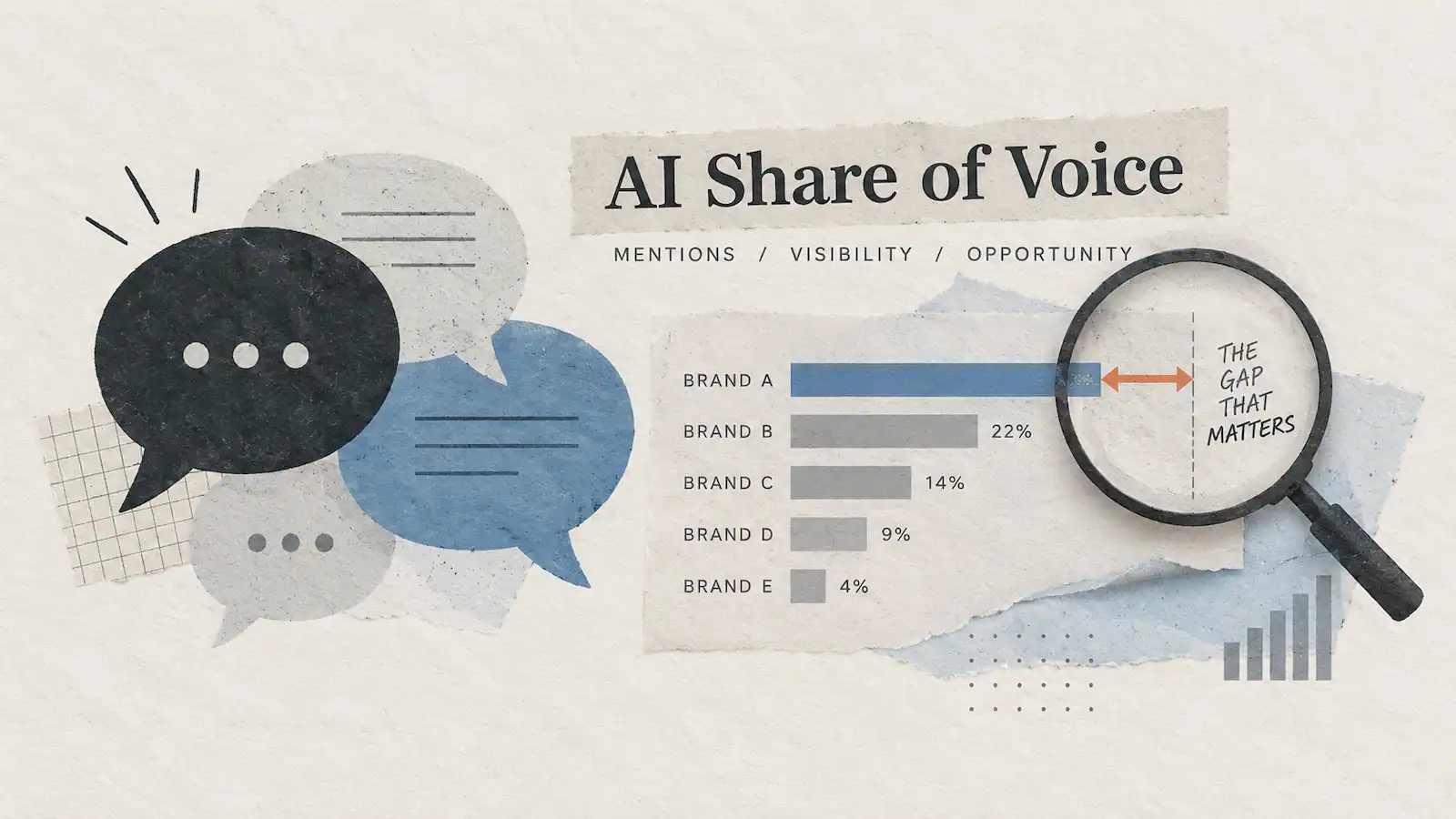
AI share of voice measures your brand’s presence in a defined set of AI answers relative to the competitors being tracked. The prompts, platforms, competitors, and calculation determine what the percentage represents. Ahrefs’ guide to AI share of voice explains why that measurement scope matters.
A score needs that context before it can guide a decision. For the scheduling product, visibility in questions about cleaning businesses would be more relevant to investigate than visibility across every kind of business software.
Examine the answer itself, not just the count. A product name in a list gives you a different opportunity from a detailed explanation of why the product fits a customer’s requirements.
How to calculate AI share of voice
One basic calculation described by Ahrefs uses:
AI share of voice =
answers mentioning your brand
÷ answers mentioning at least one tracked brand
× 100
Count an answer once in the denominator even when it names several tracked brands. Within an answer, count each brand once regardless of repeated appearances; Ahrefs counts a mention once when a brand appears at least once in an AI response.
Consider this fictional sample. Each question produces one saved answer, and the tracked brands are your product, Product B, and Product C.
| Customer question | Tracked brands named in the answer |
|---|---|
| Which scheduling tools suit a small cleaning business? | Your product, Product B |
| Which tools help manage staff availability? | Product B, Product C |
| Which tools support several cleaning crews? | Product B |
| Which software handles recurring cleaning appointments? | Your product |
| How should I prepare to move away from spreadsheets? | None |
Four answers mention at least one tracked brand. Your product appears in two, giving it 50% AI share of voice under this formula. Product B has 75%, and Product C has 25%.
Those percentages total 150%. The overlap follows directly from counting answers that can name multiple products.
Two other calculations produce different results for your product:
- Appearance rate across all saved answers: two out of five, or 40%.
- Share of all brand-answer appearances: two out of six, or approximately 33.3%.
All three calculations describe the same fictional answers. Their denominators answer different questions. When comparing reports, ask for the formula behind the label.
What changes when prompts are weighted?
The example above gives each answer equal weight. A monitoring tool may assign greater weight to prompts it estimates have more demand.
Ahrefs’ AI-adjusted volume documentation describes a model using the parent keyword’s Google search volume multiplied by a platform-specific ratio. Those ratios come from Ahrefs’ aggregated data on the website traffic each AI platform sends, measured against Google organic traffic. The resulting estimates feed its impressions and share-of-voice calculations.
That makes the weighting a model of demand. It does not establish how many individual people saw a particular answer.
Keep business relevance visible alongside any demand estimate. A broad scheduling question might attract more interest, while a specific question about recurring cleaning jobs might better match the product’s customers. Report both groups so the broad topic doesn’t determine the entire content plan.
Build a useful measurement plan
Organize the first report around three decisions: choosing software, checking whether it supports the workflow, and planning a migration.
Choose questions from customer conversations
Review recent sales calls, support requests, and product demonstrations. Write down the questions people ask before deciding whether the product fits.
An initial set might include questions about recurring appointments, staff scheduling, customer reminders, setup effort, and importing existing records. Include limitations customers need to understand, too.
Begin with about 20 questions if the team can review that many carefully. That’s a suggested workload, not a statistically representative sample of customer demand.
Keep questions that name your brand in a separate group. A prompt asking about your product’s features tests a different situation from an open question about suitable software.
Save the evidence behind each result
Use a worksheet with one row per answer. Record the exact prompt, date, platform, relevant mode and location settings, full response, and cited URLs. Assign each answer to a customer decision so you can inspect the patterns later.
Then add your own review fields:
| Review field | What to record |
|---|---|
| Brand presence | Which tracked products appear |
| Recommendation | Whether the answer suggests your product for the stated need |
| Accuracy | Whether the capabilities and limitations match current documentation |
| Sources | Which pages support the answer and whether they are current |
| Follow-up | The specific issue worth investigating and its owner |
These fields let the team act on an answer even when its contribution to the overall score is small.
Use tools to reduce collection work
Ahrefs’ Brand Radar documentation describes a response index of more than 405 million search-backed prompts, custom prompt tracking for your own questions, and reports of mentions, citations, and cited domains, with filters and saved reports.
Use the existing index to investigate unfamiliar questions and sources, then maintain a focused prompt set for the decisions already identified. Before relying on automated counts, inspect examples involving abbreviations, common words, and similarly named businesses. An ambiguous match deserves a manual check.
Save a separate view for each platform you monitor. That makes it easier to connect a finding with the actual answers that produced it.
Turn visibility gaps into specific improvements
Suppose the scheduling product appears frequently in general software answers but rarely in answers about recurring appointments. Start by inspecting what those answers say and cite.
The next action should follow the problem you can verify:
| Finding in the saved answers | Improvement to investigate |
|---|---|
| Your product’s recurring-job feature is missing or misdescribed | Clarify the feature page with current capabilities, examples, and limits |
| An older external profile says the feature is unavailable | Request a factual correction and document the source |
| Customers need migration details your website doesn’t provide | Publish a walkthrough explaining supported imports and required preparation |
| Your product is recommended for a workflow it cannot support | Make that limitation explicit in relevant documentation |
| Visitors reach the right page but struggle to evaluate fit | Improve the demonstration, pricing explanation, or inquiry process |
Technical access also deserves attention. For Google’s AI Overviews and AI Mode, Google’s documentation says supporting pages must be indexed and eligible to be shown in Search with a snippet. Its guidance includes crawl access, internal links, and important information available as text.
Check those requirements before commissioning another article, then choose the page or correction that most directly helps a customer make the decision being tested.
Report progress with enough context to assess it
There is no universal target percentage: comparisons depend on the competitors, prompts, platforms, and methodology. Ahrefs also cautions that the score shifts with how you set up brand and competitor entities, and that the AI systems themselves change. Those are reasons to investigate a change before attributing it to your marketing work. Ahrefs’ interpretation guidance covers these limitations.
Review the saved answers monthly and maintain a dated change log. Record page updates, external corrections, and changes to the tracking setup. Keep the previous configuration available when introducing a new prompt group.
A useful report could read:
In this illustrative report, our product appeared in 12 of 40 saved answers on one platform. Thirty answers mentioned at least one of the four tracked brands, giving us 40% AI share of voice under the unweighted formula. Two answers misstated our import capabilities. The next action is to update the migration documentation and check the cited external profile.
Alongside that report, review identifiable referral visits, trial quality, qualified inquiries, and customer feedback about how they discovered the business. A visibility score cannot establish a sale or explain every step leading to one.
For the scheduling company, the useful outcome of the first review might be a clearer migration guide and a corrected product description. Assign an owner to each, publish the changes, and inspect the relevant answers again at the next review. That gives the measurement a concrete job in the marketing process.