Introducing Ultramarine 1 Flash
For knowledge work, most AI produces the same-looking documents. PowerPoints, Excel files and Word documents often look as if they were made by the same person, regardless of which AI you used. Maybe the human collective was not that good at making nice-looking documents in the first place. That was my first thought when I saw Paper Instruments announce Ultramarine 1 Flash. I assumed it was about making prettier slides.
What it is
Ultramarine is a language model meant to power AI agents that complete multi-step business assignments. A company building an agent for financial analysts, lawyers, consultants or operations teams can use Ultramarine as the model that decides which files to read, which information to trust, what calculations to make and what to update. The agent software gives it access to files and business systems, and Ultramarine supplies the reasoning. Paper Instruments offers it through an API, trained and evaluated inside Feather, the company’s own agent harness.
The company says the post-training was done by a team of five for about $300,000 all-in, on top of an existing open model, GLM-5.3 Flash. The announcement post is the CEO’s.
What it does with a messy assignment
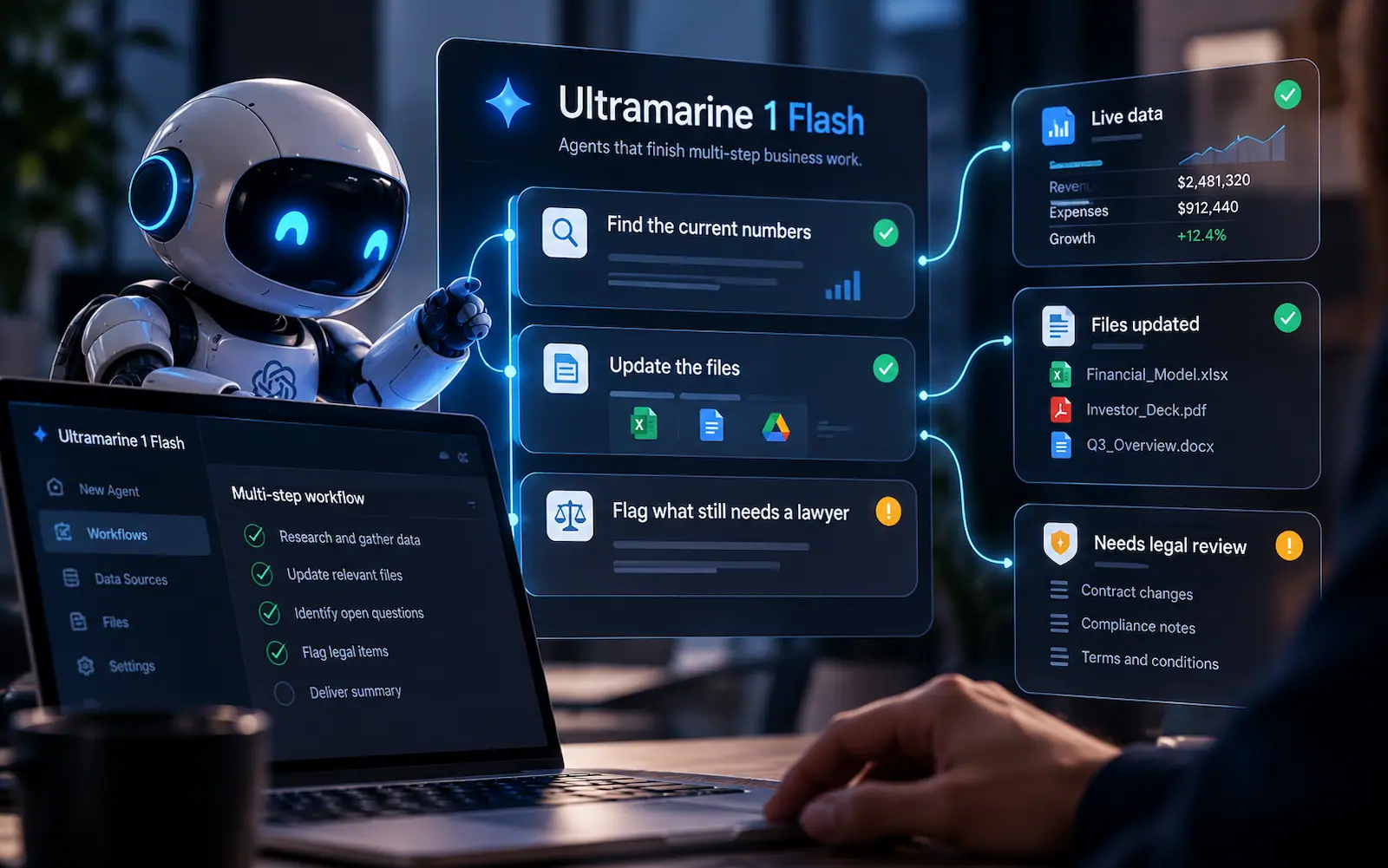
The example in Paper Instruments’ report is more helpful than the product description. An agent is asked to update a board briefing after management changes its financial forecast. The new numbers are in one place, while an old forecast remains in draft disclosure materials. The agent must find the current figures, recalculate the valuation, edit the right part of the briefing and explain what still needs a lawyer’s approval. A good result is an accurate update the board can use. Making the document look nice is one small part of the job. The training also includes work in CRM and ERP systems, where the agent may need to update records instead of producing a document.
Why train a new model
Building a new model for this is a specific bet on training. Paper Instruments generated simulated work assignments across finance, law, consulting and operations. Each assignment has files, tools and a checklist of what the finished work must get right, and reinforcement learning rewards the model for completing the whole task correctly. The goal is an agent that can work through messy source material and leave the files or records in the right state, rather than just answer a question or draft text from a prompt.
I can see the appeal. When a forecast changes, someone may have to update a spreadsheet, a presentation and a written explanation, then check that they all agree. If an agent can handle that chain of work reliably, people spend less time copying numbers between files and more time reviewing the decisions. Paper Instruments says Ultramarine scored better than its starting model on all six of its knowledge-work benchmarks, by 4.1 points on average, while generating 6.5% fewer tokens. Those are company-reported results. I would still want to see it tested on a real, messy project outside the company’s own setup.
Price and availability
The API is priced at $0.15 per million input tokens, $0.03 for cached input and $0.50 per million output tokens, the same as its base model. On Paper Instruments’ internal knowledge-work suite, the company measures a task at $0.13 with Ultramarine, against $8.19 for Claude Fable 5 and $2.09 for GPT-5.6 Sol, both set to maximum reasoning. The company publishes the comparison, along with its own benchmark, so the numbers are theirs, not an independent lab’s.
As of October 16, 2026, the weights are not out yet. The team says it plans to release them within two weeks of its October 14 announcement, which would also let people run it on their own hardware if they have enough of it, and the product page says the weights are coming soon. When they land, anyone with the hardware can test the model on their own documents. That is the release to watch.