AI Is Learning to Read a Cell’s History
A machine learning model called IRIS can infer which chemical signals a cell has been receiving, using patterns of gene activity alone. Researchers at MIT and the Whitehead Institute, led by Pulin Li and Nicholas Hutchins, developed it, and MIT announced it on October 15.
When I think about how a body develops, I find it easier to picture the finished parts than the process that produces them. A heart, a lung, a spinal cord. How do cells end up in the right places, doing the right things, while everything around them is still taking shape?
How the model reads a cell’s past
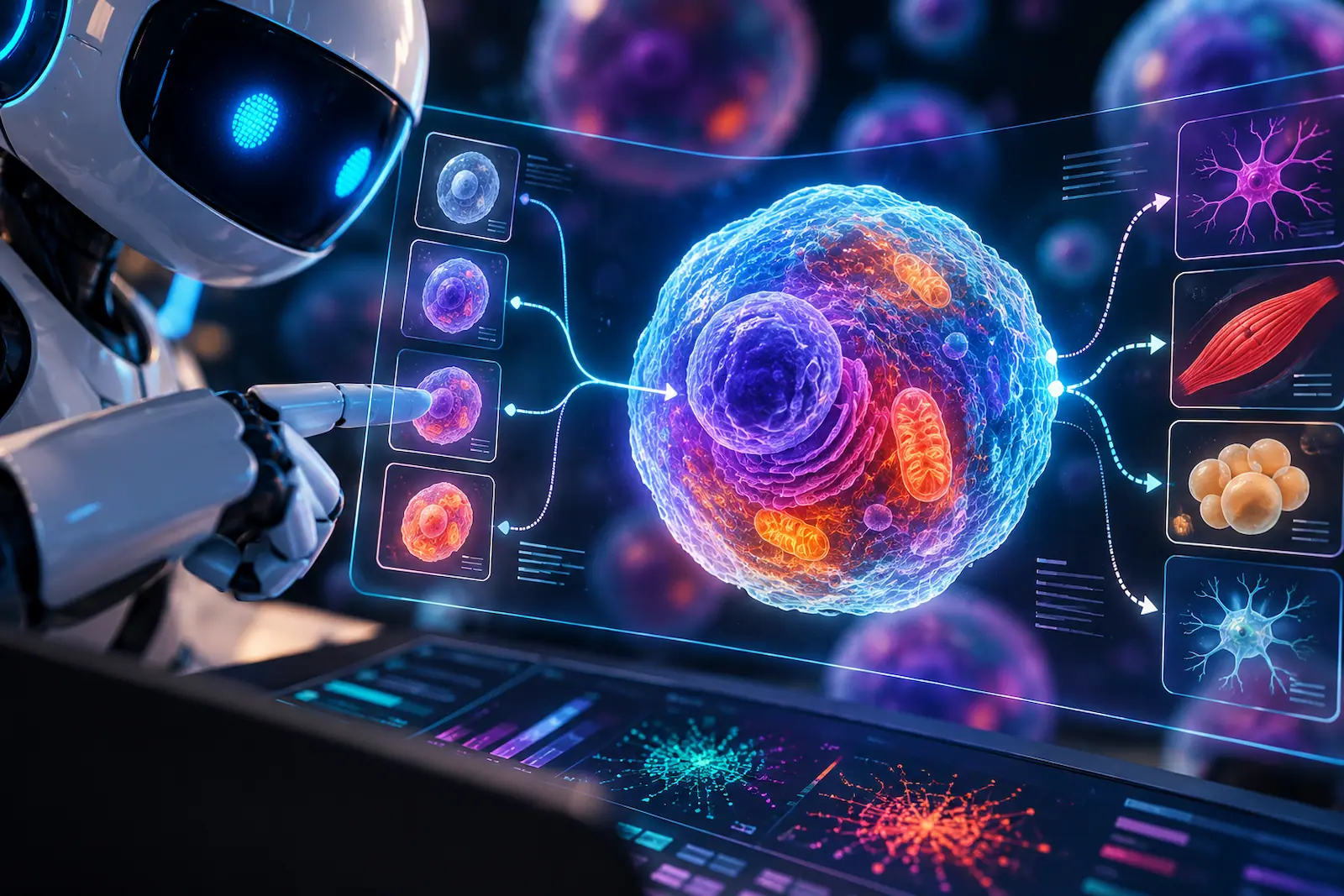
Cells send and receive chemical signals that help guide what they become. Signaling pathways translate those messages into changes in gene activity. The researchers found that these responses contain recognizable patterns shared across different cell types, so the model can work on types it never encountered during training. MIT describes these patterns as fingerprints, and the voice recognition analogy is Li’s: a system trained mainly in English can use that training to recognize other languages. That is transfer learning, and it is why IRIS can cross cell types.
That possibility interests me because it gives researchers something to carry from one experiment into another. Learning how one kind of cell responds could help them investigate a different kind.
What it found in embryos
In the study, published September 8 in Nature Methods, the team trained IRIS on experiments exposing stem cells to combinations of six developmental signaling pathways, then applied it to single-cell data from mouse embryos. The model recovered known signaling patterns as cells developed toward particular roles, including cells destined for heart, gut, muscle and spinal cord tissue.
The lung experiment
The lung experiments give the work a concrete purpose. IRIS pointed to a role for WNT signaling in establishing respiratory mesenchyme, cells involved in lung development. Experiments on cultured foregut tissue from mouse embryos supported that prediction: activating WNT expanded the tissue’s respiratory mesenchyme markers, and inhibiting it eliminated one of them. The team then improved a procedure for guiding human stem cells toward that cell type by activating WNT earlier and for longer. The resulting cells showed increased expression of markers associated with respiratory mesenchyme. The paper documents both steps.
I like being able to follow the reasoning that far. A model suggests where to look. Researchers change a condition and measure what happens. The result gives them a reason to keep pursuing the idea, revise it, or try something else. I would judge the model by how often that process leads to a result researchers can use.
The limits
There are still questions about how widely IRIS will work. The authors say reconstructing signaling histories depends on correctly inferring how cell populations are related as they develop. They also note that changing WNT alone is unlikely to produce respiratory mesenchymal cells fully equivalent to those in a body. Those limits appear in the paper’s discussion and results.
One potential use is improving organoids, small laboratory models that reproduce some features of organs. MIT discusses how better models could support disease research and drug testing. Whether a new method makes those models more useful depends on the particular question a researcher needs to answer.
The researchers have also made their code available, which gives other groups a way to examine the method and try it on their own questions. I would be interested in what they find when the cells or experimental conditions differ from the original work.
I keep coming back to the possibility of learning enough about a cell’s past to make a better decision about its future. If researchers can use that knowledge to choose more informative experiments, each result could help them ask a more precise question. How much faster could our understanding of development grow if more of those questions became practical to test?