AI Helped Find Exact Solutions to a 59-Year-Old Fusion Problem
“Promising candidates appeared within hours.”
That sentence appears in the October 5 preprint by Opal Issan, Jonathan Citrin, Matt Landreman, and Brendan Tracey. The researchers used Gemini 4 agents to extend recent discoveries in fusion mathematics, then worked through the new findings and verified them systematically. The speed caught my attention first. So did the possibility of taking a newly published result, asking what comes next, and getting a useful answer while the original work is still new.
The problem being solved
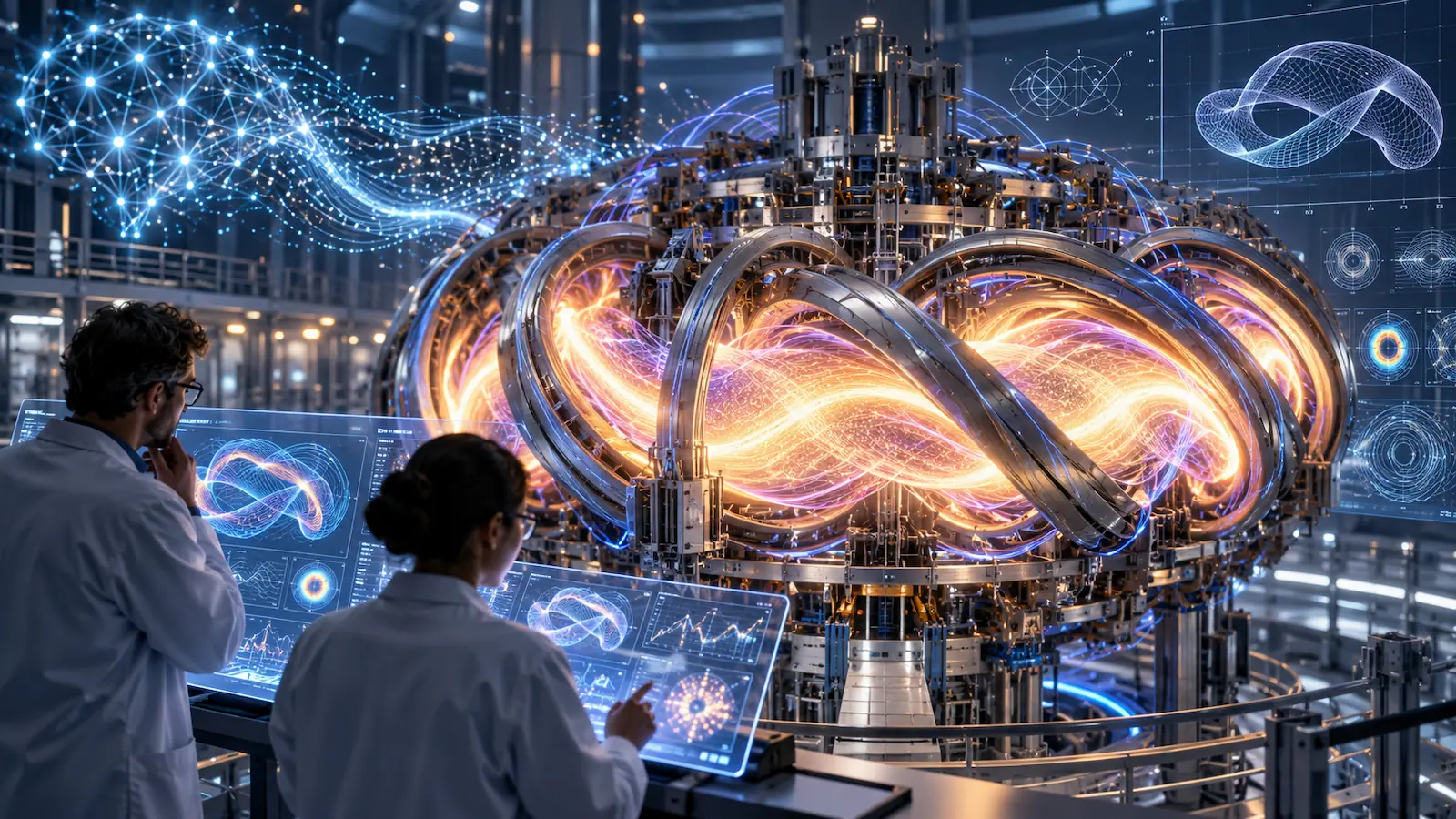
The setting is stellarators, machines that use twisting magnetic fields to hold plasma in a doughnut shape. Their complicated geometry gives researchers more choices about how to confine that plasma, while making the machines harder to design. The Department of Energy’s explanation of stellarators describes how computing and plasma theory help researchers improve those designs.
Inside the mathematical model, magnetic forces must balance the plasma’s pressure gradient. Researchers want smooth solutions with nested magnetic surfaces: layers shaped like doughnuts inside other doughnuts. Harold Grad’s 1967 conjecture questioned whether families of such equilibria with varying pressure could exist without certain symmetries. A September counterexample paper explains the conjecture and its history.
A counterexample is an actual configuration satisfying the conditions the conjecture says cannot coexist. It changes what researchers know is possible.
Two papers in two days
On September 21, 2026, Javier Gómez-Serrano, Lukas Liehr, and Mitchell A. Taylor submitted Counterexamples to Grad’s conjecture, establishing families of smooth equilibria without the conjectured symmetries. Their paper carries an explicit LLM usage disclosure: the authors set up the problem and a roadmap in July, then used GPT-5.6 Sol, Claude Fable 5, and Claude Opus 5 to fill in technical details, assist with calculations, and write the Lean code that certifies the results. All mathematical statements and proofs were checked by the authors.
The next day, University of Maryland physicist Matt Landreman submitted a paper with two families of explicit analytical solutions. These express the magnetic field and pressure through elementary functions, and both families have finite rotational transform, which describes how field lines wind around the torus. The acknowledgment is direct: “These solutions were discovered using the artificial intelligence model GPT-6 Astra Pro, which was also used to draft parts of the manuscript. All equations were confirmed manually by the author.”
What the agents did next
The October team then supplied Landreman’s paper and a list of its open questions to a small team of Gemini 4 agents running in Google Antigravity, an agentic development environment. The agents generalized both solution families to break a geometric property called stellarator symmetry, adding a parameter that restores it when set to zero. Gemini 4 Argon also helped draft the manuscript and write symbolic and numerical verification code. The authors chose the problem, steered the agents, and ran several rounds of adversarial review; their paper states that every derivation was independently re-derived and checked symbolically.
The hours in that opening quote refer to the arrival of promising candidates. The paper does not say how long the subsequent checking and preparation took. That work is part of the discovery too.
Why exact solutions matter
There is a practical reason to care. Exact solutions give researchers known answers against which to check numerical equilibrium codes. If a simulation cannot reproduce a known solution, researchers have a concrete problem to investigate. Landreman identifies this use in his discussion
My reading is that these are advances in the mathematics and verification tools supporting fusion research. A working power plant would still need to satisfy many demands beyond the equilibrium equations, including keeping its plasma stable and its components functioning.
What interests me most is the next step in that process. A scientist can check a candidate, establish what it means, and use it to ask a more ambitious question. As of October 2026, the checking remains the slow part. If AI keeps shortening the search between those steps, researchers may get through more of those questions.